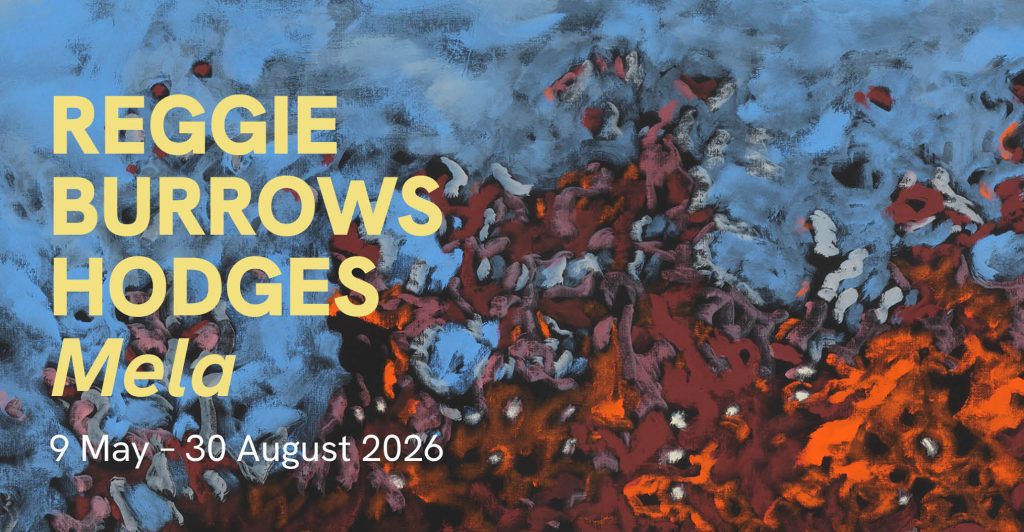
In 2024, Reggie Burrows Hodges alighted on the island of Malta to witness an as yet-unfinished construction of Malta’s newest museum – the Malta International Contemporary Art Space.
Edith Devaney, MICAS’s Artistic Director, had long admired the work of the Compton-born, Californian artist, who had been approached by MICAS’s international committee chair, the gallerist and collector Waqas Wajahat, to consider being part of the launch artistic programme.
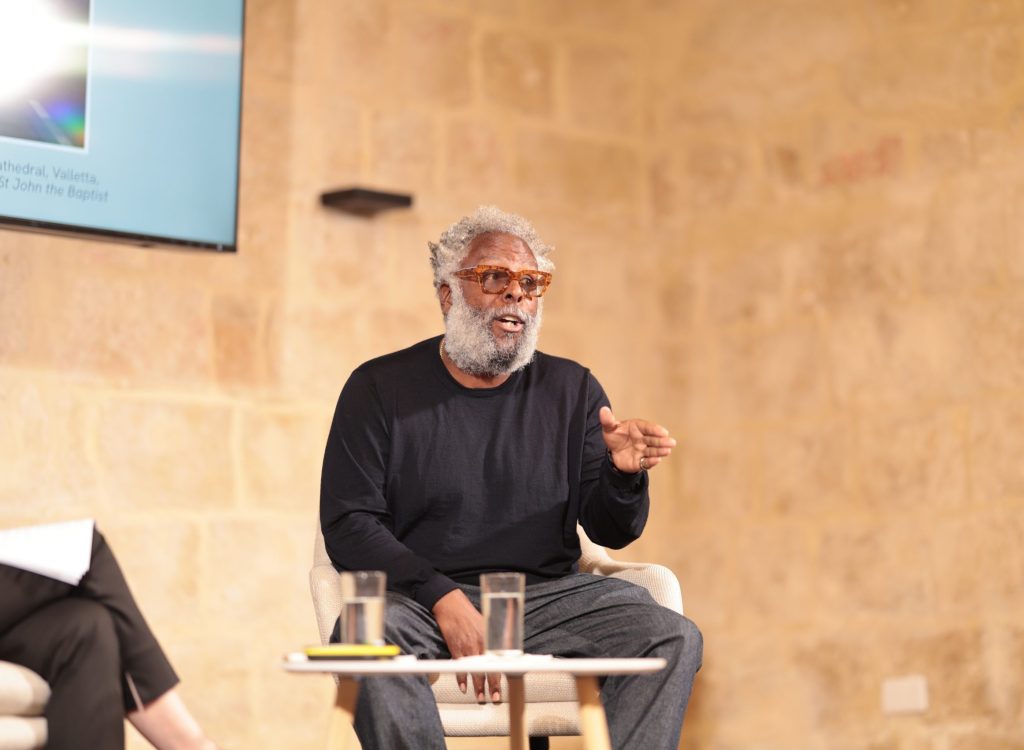
“We realised it was a leap of faith. The building wasn’t finished. We didn’t know what it was going to look like completely and for Reggie to say ‘I’ll do it’ was really something,” Devaney told the audience at MICAS’s Art Talk, held on 9 May, the day Reggie Burrows Hodges: Mela, his first European solo exhibition, opened to the public.
The most extraordinary thing was that a few weeks before MICAS opened, Hodges had informed Devaney he was going to come to live in Malta to do the work there. “You called me and you said you might think I’m crazy but I’ve made a decision… I was stunned and delighted. We always encourage artists to come visit us, because it’s really important for us that artists experience Maltese culture and history. But we expect a few days, a week at most.”
Hodges committed a year, uprooting himself to come to a completely different culture and absorb the history, as well as the artistic history, the social climate and everything to do with being Maltese.
And it was in those first days that Hodges visited the St John’s co-Cathedral in Valletta to admire Caravaggio’s The Beheading of Saint John the Baptist, his greatest, only signed work. It was then that, even in the unfinished MICAS, Hodges was already visualising how the ancient that runs all the way down the tiered galleries of the museum, would be the space where Mamajamma (2025) now hangs.
“I mean, how do you expect me to like you know recover from that?” Hodges said, recounting his encounter with The Beheading. “And that was the truth. I couldn’t believe it. As an artist you get to dream and sort of fantasise and transport yourself, not physically, but all over the world.
“I was a student of all of the giants and titans that art could produce, so to come and see the Caravaggio – for a non-artist, for anyone, you don’t have to be a painter – but for a painter, you can’t describe it. It was a daunting, terrifying to even think about it.”
Hodges says it was clear to him then that this creative kernel in his mind had to be resolved. “In whichever way it manifested itself, Mamajamma needed to be there and presented.”
And that in itself was a challenge taken on wholeheartedly by MICAS, as Hodges makes it clear. “I’ll be forever in debt about this: when you start talking about paintings of that scale, and that you’re gonna hang them from the where, and you’re gonna let it drop into the what… how that gets done, it’s the effort of many. No one flinched.”
For working at that scale can be almost impossibly difficult on one continuous canvas – but at 4m by 8m, it appears Hodges completely understood the volume of space in the museum, “not too big, not too small, absolutely perfect” says Devaney about its presence, without it ever being overwhelming. Hodges demystifies the process as a back-and-forth process with the MICAS exhibition team led by Guillaume Dreyfuss. “It could not look like a tile or a flag. It had to have oomph, structure… a lot of thought went into it, but from my perspective it had to hold the space. It had to be powerful enough to be fixed and sit within the space.”
But the challenge for Hodges was that the large canvas still was not his style. “What was the expression going to be? That went through many iterations.”
Indeed, Mamajamma was the last canvas that Hodges completed. “I was scared. You know how you put things off? There was plenty to keep me procrastinating, but in my mind’s eye, I had the Caravaggio hanging over my shoulder. But it gave me time to kind of distance myself, remove the fear of attempting something like that, remove all of the trepidation of doing something like that.”
The result was, Hodges says, an ode to Caravaggio. But he struggled in some way to get his head around it, until he could finally discover the tone or the musical key to his work. It was then that colour, palette, and texture appeared to come together for him to distill the spirit of the work.”
The elements Hodges embedded within the composition that look back to the Caravaggio, can be seen in terms of the action being on one side of the canvas – a waterpolo match, a common sight in many Maltese seaside villages – and having space on the other side, the two figures watching, framing the activity – with the image of Salomé bearing her platter, waiting for the head of St John at the back of the pool.
Hodges proposes sport as a new religion whose gladiatorial spirit commands the worship of millions globally. “We knew that the Church’s intention for the Caravaggio was to have the blood of St John spill into the congregation, allegorically… I was proposing that new platform, as I experienced it in Malta, waterpolo,” Hodges says, with the island’s Premier Division teams rolling off his tongue. “This is committed, gladiator stuff and also a joyful way to gather communities… a new worship.”
The Beheading’s elements are presented in Mamajamma with the maiden – a maternal figure that exists in many of Hodges’s paintings – the blood dripping onto the deck of the pool… as for the two figures in Caravaggio’s prison window, Hodges figures they would have escaped by now. But this idea went through countless iterations before Hodges honed in to his waterpolo concept. “It won over some of the other strategies to make that work… because a big intent was also how the people of Malta would see it, how engaging it would be for them.”
Then again, Hodges also admits to the practicalities of painting at such a large scale. In Mamajamma he was preoccupied with such aspects as to how to address the water and its vibration, or even the quantities of paint required for the canvas. We see the artist at play in his Mamajamma Study: Water Works (2025), a work in which the abstraction of the waterpolo players is presaging the translucent water in Mamajamma, for whom Hodges says there was just one shot at. “I couldn’t mess it up. To recover from that, we would have been out of time. In this case, I’m really exploring, I’m getting a chance to play.”
The unmistakable grid-like roof of MICAS is captured beautifully in Labor: Place of Honey (2025), Hodges’s depiction of his visit in 2024 to the as-yet-unfinished museum. Capturing the nervous silhouettes of Devaney, her exhibition assistant Martina Darmanin, and MICAS chairperson Phyllis Muscat, the latter has lovingly dubbed it ‘Women on the Verge of a Nervous Breakdown’, such was the anxiety at the time of seeing MICAS completed.
“It was quite the vision,” Hodges says, recalling his walkthrough into a museum that had no closed walls. “It stayed with me. The light was doing a different thing then, than it even is now It was a complete shell of potential; so much was happening, and so much was happening to them. I’m kind of outside of it, just observing…”
The other piece to the story is that he felt compelled to turn the rare opportunity of witnessing the place in its raw state, into a work others could not do. “The sportsman in me, a little bit competitive, was that I had one leg up on all the great painters that followed. That was my war: I was like they’ll be able say, ‘ah, he was all right. But then they could say, but he didn’t do that one’.”
Through his Labor series, Hodges’s mind takes us to unchartered territories. In Labor: Poem of the Seabed, he wonders whether the origin of work itself can be located at the bottom of the sea. In Labor: Limoncello, an abstracted image of the rugged Maltese coastline features figures running on the beach – but it was also the time of a Scirocco wind that had brought over the Sahara sandstorm to Malta at the end of summer. That texture in the Maltese air was the birth of Limoncello. “That act of nature… that the winds could kick up this texture and bring it through and past Malta, the haze, was the way these paintings come to be.”
That same sensitivity is present in the history of those artists being incredibly sensitive to atmospheric changes, such as Turner painting the atmospheric changes of light that happened with the volcano, or Monet painting London smog.
The most abstracted of Mela’s works are The Buoy series, which feature paintings of the sea with a timbre that is unmistakably Hodges’s. Even after leaving California, the familiarity of the sea, perhaps also captured in a poster print his Compton childhood home had of Winslow Homer’s Watching the Breakers: A High Sea (1896), stayed with Hodges even after moving to New York. Just like Hodges’s silhouettes, Homer’s work features three ‘watchers’ whose identities, or gender or nationality, remain unresolved. In Hodges’s human representation, the negative spaces with a black round become completely embedded within the environment built around them.
“The idea was that we’re products of our environment, and then let the figure emerge. So the most pure thing in the painting was the ground, and I never touched the figure, which out of that purity, and out of blackness, it would emerge,” Hodges says.
“I thought it was extremely powerful for me, that everyone could see themselves in these figures, stand-ins for humanity in the most pure way. The fact that they come from the ground, that they surface from their environment around them, was a way of thinking and approaching my figuration.”