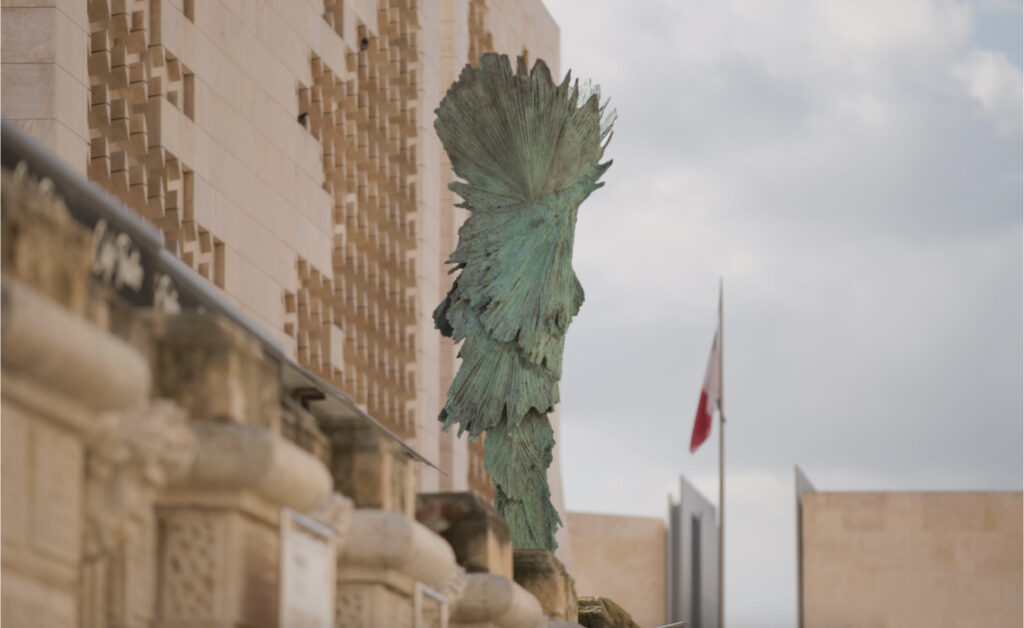
The Palm Goddess for Malta, portrait by Anders Overgaard
In 2022, MICAS hosted the internationally celebrated Michele Oka Doner whose The Palm Goddess for Malta embraced the figurative tradition of the ancient past with a sculpture inspired from the monumental leaves of Phoenix dactylifera, a palm that inhabits the Maltese archipelago.
Celebrate the human form in ancient Malta has been celebrated as world patrimony since the dawn of art’s historical reference. The use of the figure even predates the building of stone temples, so primary is the human form to the culture of the island.
The abstract but definitely female form is a four-metre high, soaring figure held aloft on a “trunk” that symbolises growth from the Maltese soil. Just as the vast majority of archaeological finds represent a deity, something sacred, The Palm Goddess for Malta embodies human aspiration and the desire to be lifted up and moved forward by creative expression.
Cast in bronze and patinated green, its palm motif provided Valletta’s parliament square a beautiful and timeless image.
Michele Oka Doner is an internationally renowned artist whose career spans five decades. Born and raised in Miami, she maintains a studio and residence in Soho, New York.
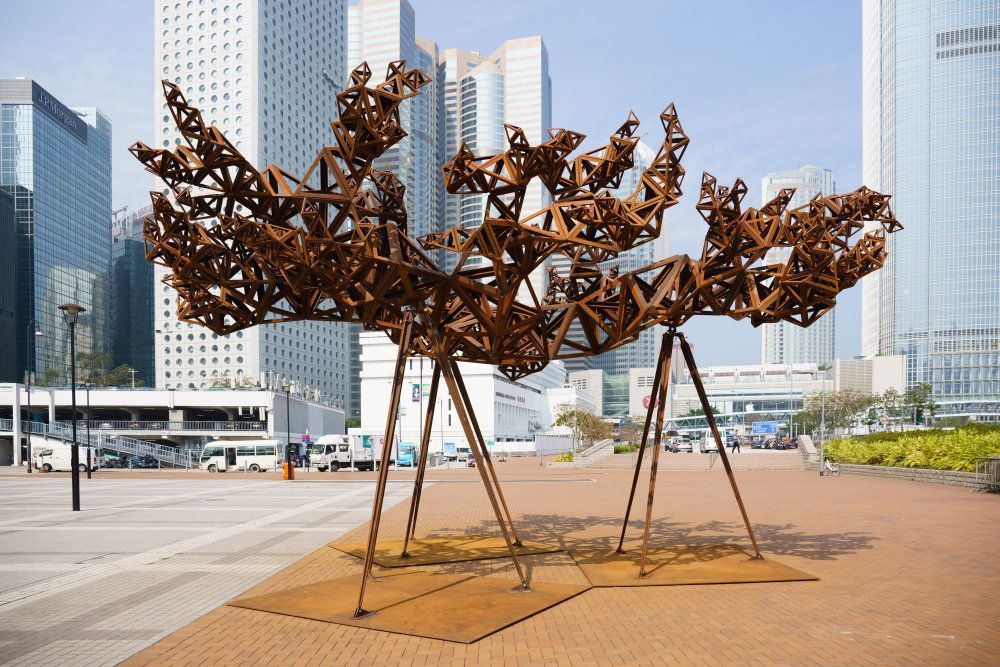
The Dappled Light of the Sun (Formation 1)
The celebrated British artist Conrad Shawcross (b.1977) was one of the first artists to visit Malta as a guest of MICAS, immediately connecting with the history and geography of Malta, finding inspiration in the location of the MICAS site, its history, proximity to the sea and the marina, and the views it afforded from its high areas.
In 2023, MICAS worked closely with Shawcross to curate a display of his works across the MICAS site, which is now in the final stages of construction.
The Dappled Light of the Sun (Formation I), acquired by MICAS as part of its permanent collection, is constructed in welded weathered steel Made in 2015 and first shown in London, it was originally exhibited as a set of five unique clouds arranged as a vast canopy in the courtyard of the Royal Academy of Arts. These other companion pieces are now all in international collections.
The sculpture is comprised of a large, floating, cloud-like structure, which is formed from thousands of bolted tetrahedrons propped nimbly on a set of three tripods. With a height of nearly five metres, its monumental scale enables the sculpture to be immersive, encouraging viewers to walk beneath and around it, experiencing the changing patterns created by dappled light passing through the complex, geometric canopy. The work embodies the artist’s deep fascination with mathematical theory, as well as his engagement with the natural world.
[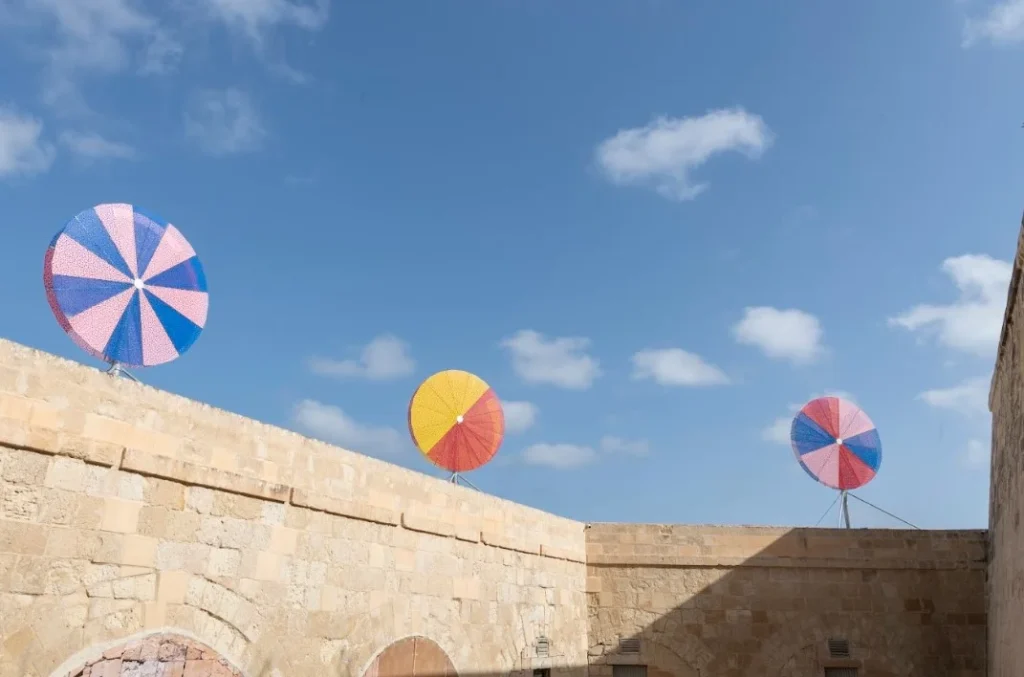
MICAS Beacons, by Conrad Shawcross